
What is a Watch Winder?
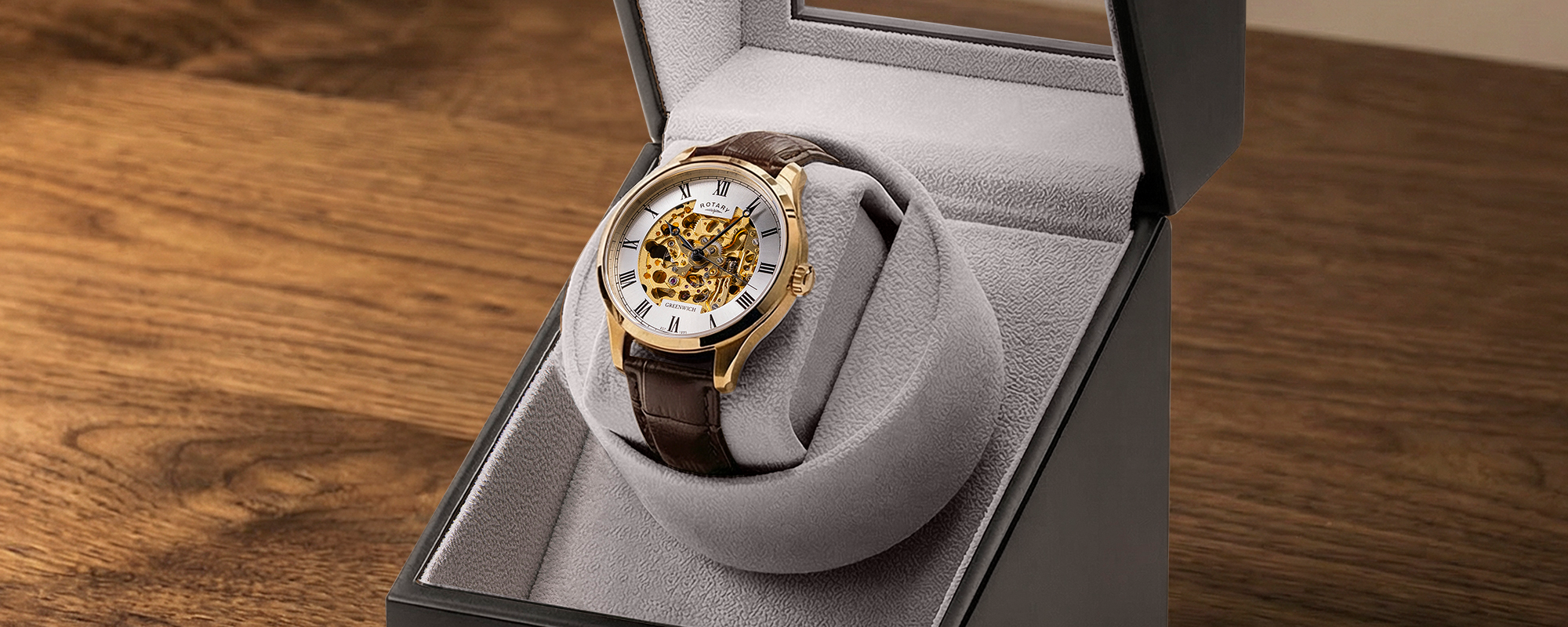
A watch winder gently rotates an automatic watch at controlled intervals, replicating natural wrist movement. This keeps the mainspring correctly tensioned and allows internal lubricants to remain evenly distributed across the movement.
A well-designed watch winder:
-
Keeps your automatic watch running accurately
-
Maintains date and GMT complications
-
Reduces unnecessary resetting
-
Supports long-term mechanical health
Why Build Quality Matters
The most important component of any watch winder is the motor.
Poorly engineered motors can introduce grinding noises, inconsistent rotation, and premature failure - often leading to returns or long-term reliability issues. A premium motor, by contrast, delivers smooth, quiet operation and consistent performance over years of use.
This is why we have selected a high-quality, low-noise winder with refined construction, designed to complement fine mechanical watches rather than overwhelm them.
Understanding Watch Winder Settings
Modern watch winders allow control over two key variables:
Turns Per Day (TPD)
TPD refers to how many rotations the watch completes in a 24-hour period. Different movements require different amounts of motion to remain fully wound.
Our watch winder offers four selectable TPD settings:
-
650 TPD
-
950 TPD
-
1250 TPD
-
1850 TPD
This range ensures compatibility not only with modern Rotary watches, but with a wide variety of automatic movements across the industry.
Direction
-
Clockwise (CW)
-
Counter-clockwise (CCW)
-
Both (bi-directional)
Some movements wind in one direction only, while others wind efficiently in both. Adjustable direction ensures the correct winding behaviour for each calibre.
The advantage of an adjustable watch winder is simple: precision.
Recommended Watch Winder Settings for Rotary Watches
Modern Rotary Automatic Watches
Miyota 8-Series Movements
-
Recommended setting: 950 TPD
-
Direction: Clockwise (CW)
Most Rotary automatic watches use Miyota 8-series movements. These are robust, unidirectional automatics that wind efficiently with moderate motion. A 950 TPD clockwise setting keeps the watch fully wound while minimising unnecessary internal wear.
Rotary GMT Watches
Seiko NH34 Movements
-
Recommended setting: 950 TPD
-
Direction: Both (CW + CCW)
The NH34 is a bi-directional movement. Alternating rotation allows the rotor to wind evenly and efficiently, making this setting ideal for maintaining GMT functionality without excess motion.
Vintage Swiss-Made Rotary Automatic Watches
Older Swiss automatic movements benefit from a more balanced and sympathetic approach.
-
Recommended setting: 650–950 TPD
-
Direction: Both (CW + CCW)
Bi-directional rotation helps distribute mechanical load evenly across older winding systems, while the slightly broader TPD range allows flexibility depending on the efficiency and age of the movement.
Using Higher TPD Settings
While most modern automatic watches operate comfortably at lower TPD levels, higher settings exist for specific use cases:
-
1250 TPD
Suitable for heavier rotors, chronograph movements, or watches with increased internal resistance. -
1850 TPD
Intended for high-complication watches, specialist calibres, or professional testing environments where additional motion is required.
These higher settings ensure broad compatibility across modern, vintage, and non-Rotary automatic watches.
Compatibility With Other Automatic Watches
Thanks to its adjustable TPD and directional settings, the Rotary watch winder is compatible with a wide range of automatic watches beyond our own collections.
As a general guide:
-
Modern bi-directional movements: 650 TPD
-
Unidirectional automatics: 950 TPD
-
Chronographs or heavy rotors: 1250 TPD
-
Vintage or specialist movements: begin at 650 TPD and increase gradually
This flexibility ensures the winder remains suitable as collections grow and evolve.
Can a Watch Be Overwound?
Modern automatic movements are designed with protective mechanisms that prevent traditional overwinding. However, excessive rotation provides no performance benefit and may introduce unnecessary wear over time.
A properly configured watch winder focuses on controlled, purposeful motion, not constant rotation.
A Considered Approach to Watch Care
A watch winder should reflect the same values as the watch it supports: precision, restraint, and longevity.
Quiet operation, refined materials, and adjustable settings ensure each timepiece is maintained correctly - whether modern, GMT-equipped, or vintage.
For Rotary watches, and for many automatic movements across the industry, a thoughtfully set watch winder provides confidence that your timepiece is always ready, always running, and always treated with care.

Written by Fraser James